19th Century
War has always been interesting in the world of photography and has been an inspiring art form for the public. Conflicts of battle have been documented both in studio and on the battlefield by many artists. Both artists and photographers documented war but over time photography took over and the phenomenon developed throughout 3 conflicts.
'both photographers and history painters rubbed shoulders with the fringes of the
battlefield, photographers gradually took over. The photographs in the Musee d'Orsay
trace the development of this phenomenon through three major conflicts over the second
half of the nineteenth and the early twentieth century; the Crimean Wat, the American
Civil War, and the First World War.'1
Crimean War
The Crimean War was a conflict between the Russian Empire and France and Britain from 1853 to 1856 and the first war to be documented using photography by Roger Fenton who was asked by Queen Victoria to document the conflict.
'In a bid to counteract this unpopularity, Queen Victoria asked Roger Fenton, a close
friend of the royal family, to photograph the conflict.'2
War has always been interesting in the world of photography and has been an inspiring art form for the public. Conflicts of battle have been documented both in studio and on the battlefield by many artists. Both artists and photographers documented war but over time photography took over and the phenomenon developed throughout 3 conflicts.
'both photographers and history painters rubbed shoulders with the fringes of the
battlefield, photographers gradually took over. The photographs in the Musee d'Orsay
trace the development of this phenomenon through three major conflicts over the second
half of the nineteenth and the early twentieth century; the Crimean Wat, the American
Civil War, and the First World War.'1
Crimean War
The Crimean War was a conflict between the Russian Empire and France and Britain from 1853 to 1856 and the first war to be documented using photography by Roger Fenton who was asked by Queen Victoria to document the conflict.
'In a bid to counteract this unpopularity, Queen Victoria asked Roger Fenton, a close
friend of the royal family, to photograph the conflict.'2
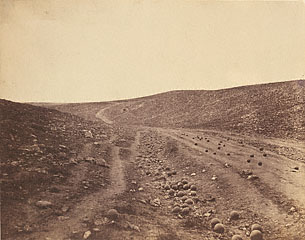
Fenton took a high number of photographs but stayed clear of documenting images of the deceased/injured soldiers or the violence itself, therefore basing his photographs around the city. Technical reasons why he avoided the actual battle was that long exposures were needed which made action photography impossible, like in this image by Roger Fenton which was said to have been taken whilst under fire and the cannonballs could possibly have been moves for effect [3]. It would also be a big risk to travel around with a darkroom as enemies would suspect him of carrying weapons.
'He took numerous photographs of the siege of the city but did not show the violence of
the fighting. The reasons were technical as much as ideological, since an exposure of
ten to twenty seconds was required. It was also risky to travel about with a darkroom in
a vehicle, which could easily be suspected of carrying military equipment and attract
enemy fire.'4
The American Civil War
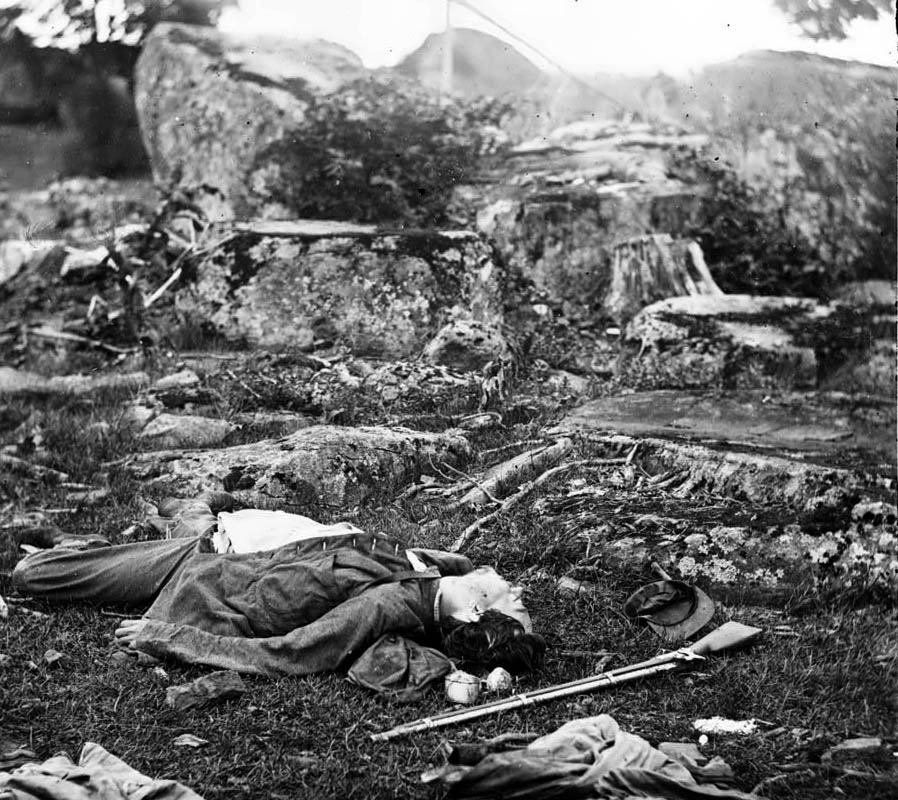
The American Civil War was a conflict between the Northern States (the Union) and the Southern States (the Confederates). Many photographers documented this war, one of them being Matthew Brady, an American portraitist. The images the photographers took of this war were much harsher than that of the Crimean War as thr visual effects, as shown in this image [5].
'they gave a harsher version of the war than their colleagues in the Crimea. They did
not hesitate to photograph human casualties, the wounded and the dead.'6
Matthew Brady also staged photo's [7] for visual effect. You know it is staged because long exposure times were required to take action shots which was not possible.
'He took numerous photographs of the siege of the city but did not show the violence of
the fighting. The reasons were technical as much as ideological, since an exposure of
ten to twenty seconds was required. It was also risky to travel about with a darkroom in
a vehicle, which could easily be suspected of carrying military equipment and attract
enemy fire.'4
The American Civil War
The American Civil War was a conflict between the Northern States (the Union) and the Southern States (the Confederates). Many photographers documented this war, one of them being Matthew Brady, an American portraitist. The images the photographers took of this war were much harsher than that of the Crimean War as thr visual effects, as shown in this image [5].
'they gave a harsher version of the war than their colleagues in the Crimea. They did
not hesitate to photograph human casualties, the wounded and the dead.'6
Matthew Brady also staged photo's [7] for visual effect. You know it is staged because long exposure times were required to take action shots which was not possible.
[1] Joelle Bolloch. War Photography; Photography at the Musee d'Orsay. p.7
[2] Joelle Bolloch. War Photography; Photography at the Musee d'Orsay. p.8
[3]
[4] Joelle Bolloch. War Photography; Photography at the Musee d'Orsay. p.8-9
[5]
[6] Joelle Bolloch. War Photography; Photography at the Musee d'Orsay. p.13
[7]
[2] Joelle Bolloch. War Photography; Photography at the Musee d'Orsay. p.8
[3]
 |
| http://www.getty.edu/art/gettyguide/artObjectDetails?artobj=67114 |
[4] Joelle Bolloch. War Photography; Photography at the Musee d'Orsay. p.8-9
[5]
 |
| http://www.sonofthesouth.net/leefoundation/gettysburg/dead-devils-den.htm |
[6] Joelle Bolloch. War Photography; Photography at the Musee d'Orsay. p.13
[7]
 |
| http://www.beachcamera.com/blog/profiles-in-photography-mathew-brady/ |
 |
| Paul Brewer. Shots of War. p.32 |

No comments:
Post a Comment