Monday, 17 February 2014

Visual Culture- Late 19th Century

Late 19th Century

Cinema started out as a range of development processes where new devices would be invented and created to improve the visual elements of film.
          'It was an evolutionary process in which each new device or discovery inspired a fresh
           wave of emulation and experimentation, sometimes for the purpose of entertainment,
           but often in the cause of science alone.'1
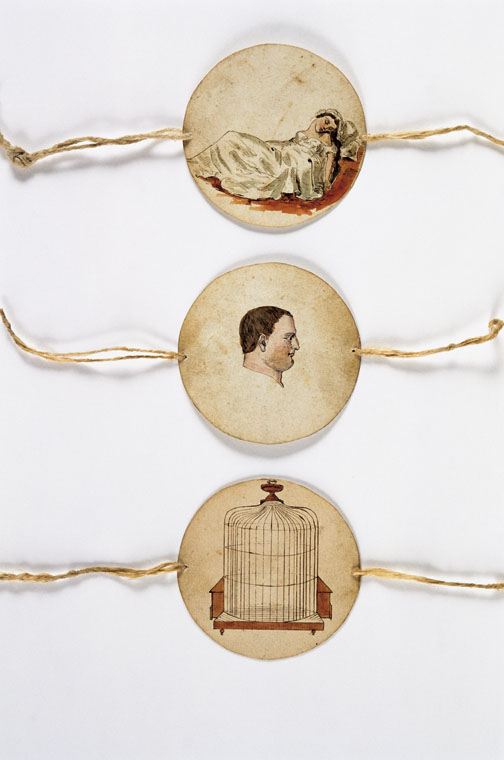
One of the first forms of moving picture was the Thaumatrope which was influenced by Sir John Herschel's 'spinning coin principle'. This was were a disc of cardboard was spun on a piece of thread enabling the images on the cardboard to be merged together to create a moving picture. 
         'Based on Sir John Herschel's spinning-coin-principle, it was a cardboard disc which
          merged the pictures on each face into a single image when spun on a piece of thread.'2
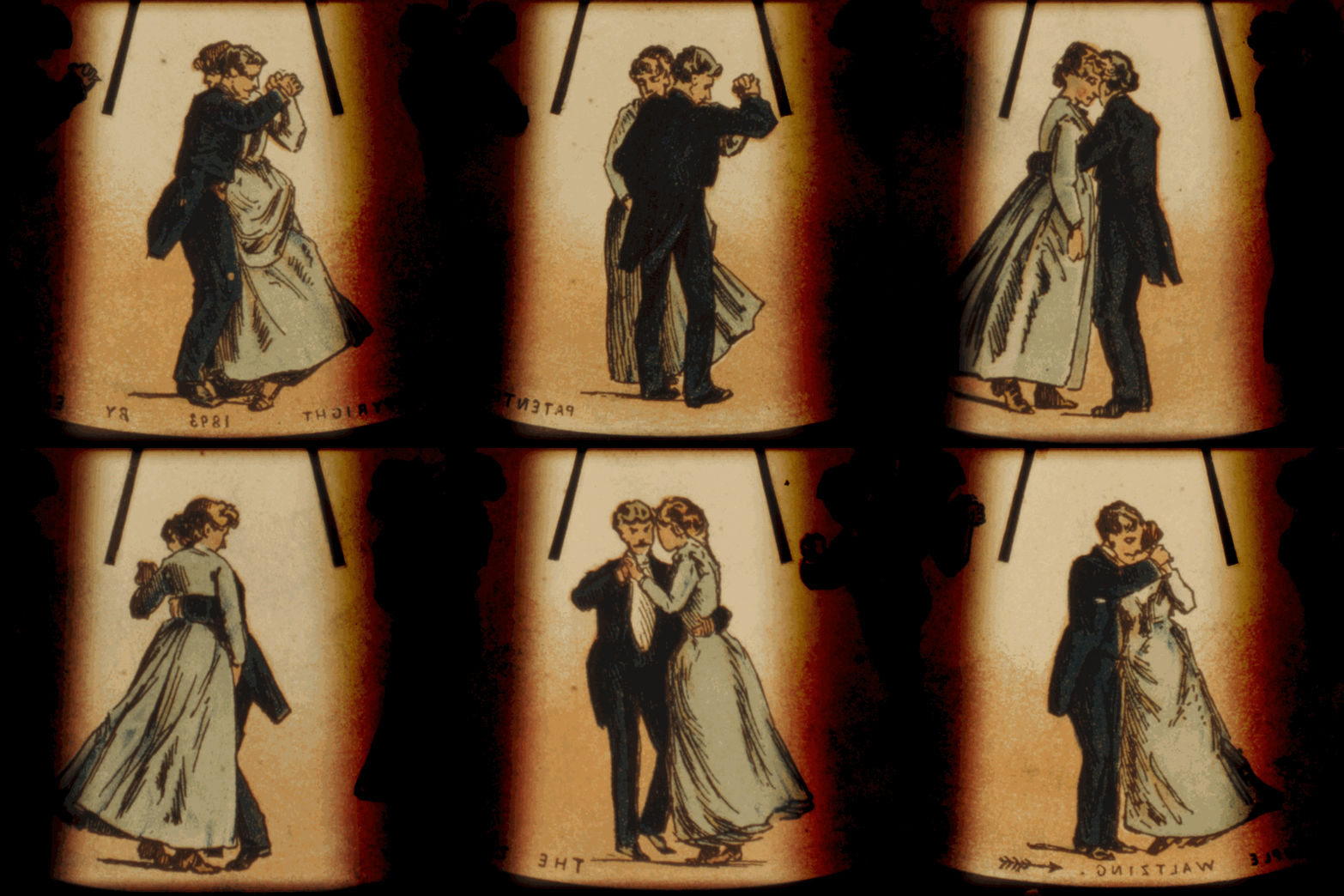
Another form of moving picture was then invented called The Phenakistoscope. This was a ridged disc with images around the edge facing out and when it was rotated it appeared to move when viewed.
          'The Phenakistoscope was a serrated disk with a series of drawings about its outer edge
           which gave the impression of movement when rotated and viewed through it's teeth in a
           mirror.'3
Over time moving picture was developed and Von Stampfer and George Horner invented similar devices as had already been invented. 
          'Von Stampfer's device comprised two discs, one slotted and the other bearing the
          drawings. When viewed through the slots the rotating drawings appeared to portray a 
          continuous action.'4
          'George Horner's Daedalum, invented in 1834, replaced the discs with a strip which gave
           an identical impression when placed around the wall of a spinning slotted drum.'5
In 1876 Emile Reynaud invented the Praxinoscope which he had developed to create bright moving images by adding mirrors to the middle of the rotating drum. 
          'His Praxinoscope (1876) replaced the slots of the Zoetrope with a polygonal drum of mirrors placed at its centre, which reflected the rotating drawings to give bright, sharp moving images.'6
As photography moved forward, series photography was developed by Eadweard Muybridge and Etienne-Jules Marey. In 1878, when fast exposure was possible, Muybridge proved that when a horse gallops, at one point all of it's hooves come off the ground.
          'Muybridge was hired in 1872by Governor Leland Stanford of California to determine whether at some stage a galloping horse had all four hooves off the ground at once...Muybridge was successful in proving the point in 1878 when faster exposure times enabled him to perfect his apparatus.'
In 1882 Marey modified the photographic revolver and then turned to roll film by the Eastman Kodak company and this is still a component in modern film making equipment.
          'In 1882, he adapted the photographic revolver...After experimenting with multiple superimpositions on a single plate, Marey turned first to the paper and then the celluloid roll film marketed by the Eastman Kodak company to produce continuous strips of images called chronophotographes. The film's regular, intermittent passage was made possible by the Maltese cross mechanism devised by the German Oskar Messter, which is still a key component of much modern movie equipment.'8
William Kennedy Laurie Dickson used his knowledge and took elements from all stages of moving picture development and created a camera called the Kinetograph in 1890. 
          'Dickson, whose genius is too often overlooked, adapted elements from every stage of the evolution of the moving image to produce in 1890 a camera called the Kinetograph and, the following year, a viewer named the Kinetoscope.'9


[1] David Parkinson. History of Film. p.7
[2] David Parkinson. History of Film. p.8
http://wernernekes.de/00_cms/cms/
front_content.php?idart=522


[3] David Parkinson. History of Film. p.8

http://en.wikipedia.org/wiki/Phenakistoscope


[4] David Parkinson. History of Film. p.8
[5] David Parkinson. History of Film. p.8
[6] David Parkinson. History of Film. p.12
http://www.magiadellaluce.com/
Pre-cinema%20animations.html


[7] David Parkinson. History of Film. p.13-14


http://en.wikipedia.org/wiki/Eadweard_Muybridge


[8] David Parkinson. History of Film. p.14-15
[9] David Parkinson. History of Film. p.15
David Parkinson. History of Film. p.14


Wednesday, 12 February 2014

Visual Culture- 1920's in Europe and Russia

1920-35 in Europe and Russia

At the start of the 1920's Soviet posters had themes such as enemies,  revolutionary ideas, literacy and health and because of their experimental texts, colours, fonts and general layout Soviet posters stood out against the art of other countries. El Lissitzky created the first example of this with 'Beat the Whites with the Red Wedge'.[1] 
          'The first such example was introduced by El Lissitzky, and published n Vitebsk in
           1920.'[2]
Photomontage was then developed by Gustav Klutsis which helped people understand aspects of the country's past and future and the society they live in. The design and the powerful colours and shapes also pay a huge part in the viusual effect of the posters.
          'Gustav Klutsis introduced the new technique of Photomontage where art and reality
           are represented in the same image.' 'Dynamic, powerfully designed, based on
           contrasting colours and shapes, these early posters offered the masses images that 
           reflected real life; they compared the country's past and future, and pointed out
           achievements in industry and the economy.' 'creating a language of signs that 
           conveyed a certain message that people would see and understand.' [3]
This became an art so the majority of people understood about the aims of the new Soviet government after the Revolution. There were many posters created and it made the citizens express more of their thoughts through imagery and posters. [4][5][6][7]  


[1] Maria Lafont. Soviet Posters. p.9


[2] Maria Lafont. Soviet Posters. p.9
[3] Maria Lafont. Soviet Posters. p.9


[4] Maria Lafont. Soviet Posters. p.29

[5] Maria Lafont. Soviet Posters. p.66


[6] Maria Lafont. Soviet Posters. p.70
[7] Maria Lafont. Soviet Posters. p.71

Tuesday, 11 February 2014

Visual Culture- 19th Century


         19th Century

War has always been interesting in the world of photography and has been an inspiring art form for the public. Conflicts of battle have been documented both in studio and on the battlefield by many artists. Both artists and photographers documented war but over time photography took over and the phenomenon developed throughout 3 conflicts.

          'both photographers and history painters rubbed shoulders with the fringes of the 
           battlefield, photographers gradually took over. The photographs in the Musee d'Orsay 
           trace the development of this phenomenon through three major conflicts over the second
           half of the nineteenth and the early twentieth century; the Crimean Wat, the American
           Civil War, and the First World War.'1

Crimean War


The Crimean War was a conflict between the Russian Empire and France and Britain from 1853 to 1856 and the first war to be documented using photography by Roger Fenton who was asked by Queen Victoria to document the conflict.

           'In a bid to counteract this unpopularity, Queen Victoria asked Roger Fenton, a close
         friend of the royal family, to photograph the conflict.'2
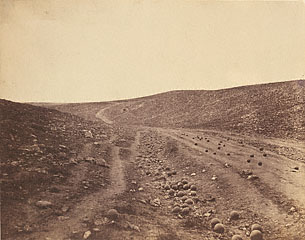
Fenton took a high number of photographs but stayed clear of documenting images of the deceased/injured soldiers or the violence itself, therefore basing his photographs around the city. Technical reasons why he avoided the actual battle was that long exposures were needed which made action photography impossible, like in this image by Roger Fenton which was said to have been taken whilst under fire and the cannonballs could possibly have been moves for effect [3]. It would also be a big risk to travel around with a darkroom as enemies would suspect him of carrying weapons.
           'He took numerous photographs of the siege of the city but did not show the violence of
            the fighting. The reasons were technical as much as ideological, since an exposure of
            ten to twenty seconds was required. It was also risky to travel about with a darkroom in
            a vehicle, which could easily be suspected of carrying military equipment and attract
            enemy fire.'4

The American Civil War

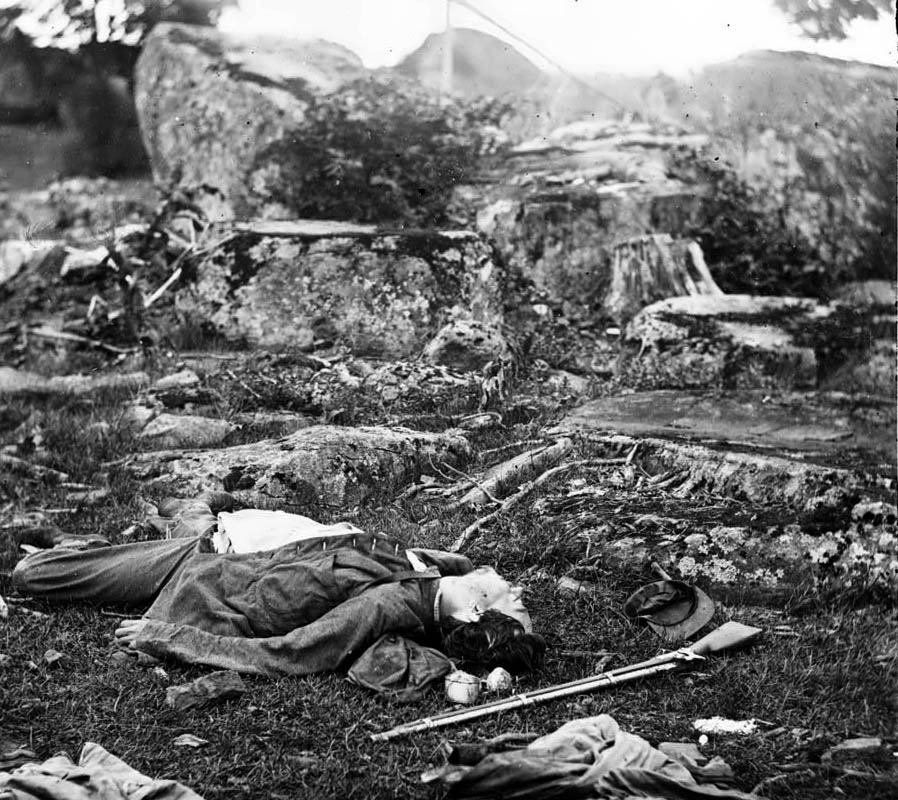
The American Civil War was a conflict between the Northern States (the Union) and the Southern States (the Confederates). Many photographers documented this war, one of them being Matthew Brady, an American portraitist. The images the photographers took of this war were much harsher than that of the Crimean War as thr visual effects, as shown in this image [5].          
           'they gave a harsher version of the war than their colleagues in the Crimea. They did
            not hesitate to photograph human casualties, the wounded and the dead.'6
Matthew Brady also staged photo's [7] for visual effect. You know it is staged because long exposure times were required to take action shots which was not possible.  


[1] Joelle Bolloch. War Photography; Photography at the Musee d'Orsay. p.7
[2] Joelle Bolloch. War Photography; Photography at the Musee d'Orsay. p.8
[3] 
http://www.getty.edu/art/gettyguide/artObjectDetails?artobj=67114


[4] Joelle Bolloch. War Photography; Photography at the Musee d'Orsay. p.8-9

[5]


http://www.sonofthesouth.net/leefoundation/gettysburg/dead-devils-den.htm


[6] Joelle Bolloch. War Photography; Photography at the Musee d'Orsay. p.13

[7] 
http://www.beachcamera.com/blog/profiles-in-photography-mathew-brady/


Paul Brewer. Shots of War. p.32


Thursday, 6 February 2014

Visual Culture- The Renaissance

The renaissance

William Caxton


The occurrence of the renaissance was between the 1400's and 1600's and it was the link between Medieval and Modern periods of European history. The time when artists became recognized as individuals was towards the end of the Medieval period. It started in Italy, mainly in Florence and it had big impacts on art forms and the experimentation behind it. Throughout the renaissance William Caxton became a printer in Westminster and his printing press was the first to be brought to England. This was 20 or so years after Gutenberg had developed printing technology which by this time had spread to other countries. William Caxton was the first printer to print a book in English, this book being The Canterbury Tales by Geoffrey Chaucer. 

http://www.bbc.co.uk/programmes/b01nbqz3


Lotte Hellinga. William Caxton
and early printing in England.
p.13

Visual Culture- 17th and 18th Centuries

17th and 18th Centuries

Artists of the 17th and 18th Centuries created paintings of still life, landscapes and everyday situations which, in most, show class, property and wealth. 

A great example of wealth, property and class in the 17th century is The Yarmouth Collection by an unknown Dutch artist. This painting shows a collection of the Paston family of Norfolk's belongings all in a typical still life arrangement. There are two main aspects which depict wealth and that is the exotic foods and the decorative objects; such as the red curtain in the background. 


http://www-hki.fitzmuseum.cam.ac.uk/research/painting/yarmouth.html


Another example is Mr. and Mrs. Andrews by Thomas Gainsborough.
Gainsborough mainly painted landscapes, portraiture and later started to develop into the likes of mythological subjects. This painting is very symbolic, the oak tree for example symbolises stability and strength which suggests wealth and high class. As the painting suggests, the couple own the land they are on which shows property and ownership. This painting depicts wealth and property highly and efficiently.

http://www.gainsborough.org/page/481/The-Artist


http://mydailyartdisplay.wordpress.com/2011/05/02/
mr-and-mrs-andrews-by-thomas-gainsborough/

Tuesday, 4 February 2014

Visual Culture- The Medieval World

China

Calligraphy

Chinese Calligraphy started in around 220BC and has developed into its own art from over the years. The most traditional way of creating Calligraphy is using a brush and ink on wood, silk or paper and it is created with fast brush strokes. Calligraphy started to elevate into an art form which was practiced by many people of the Chinese culture to become professional calligraphers.  The art of Calligraphy is more complicated than you expect. It takes time to learn the particular brush strokes in which you need to create the perfect Calligraphy. There are Calligraphy classes in China where people practice the art. As shown in the clip below. 

Chinese Calligraphy, Stephen Little. The Bulletin of the Cleveland Museum of Art. 1987. JSTOR


This clip demonstrates Chinese culture of Calligraphy and both spiritual and martial arts.

Printing

Woodblock printing was invented in China and the earliest known examples of it dates back to 868 when the oldest printed book, the Diamond Sutra, was created. Woodblock printing was overlooked by Chinese Literature1 but then later spread throughout China and was used to print books and pages of text and images. Also in later stages printing was done using a press as to being printed by hand. Between 1041 and 1048 movable type was also invented in China, this is where the characters were able to be moved around to create a variety of sentences and phrases. This technique was used to print banknotes and as the art of printing developed a mechanical press was produced by Johannes Gutenberg and this led on to the printing and binding of books and the first mass production. Printing is considered to be a cheap and excellent form of creating propaganda posters etc. Also due to printing education and Literacy expanded throughout Europe.


Small stamped images of the Buddha; one of the ways
that woodblock printing began. 2


Rubbing from a carved stone slab. 3

A woodblock carved with four pages of text. 4


[1] Frances Wood and Mark Barnard. The Diamond Sutra: The Story of the World's Earliest Dated Printed Book p. 63
[2] Frances Wood and Mark Barnard. The Diamond Sutra: The Story of the World's Earliest Dated Printed Book p. 65
[3] Frances Wood and Mark Barnard. The Diamond Sutra: The Story of the World's Earliest Dated Printed Book p. 69
[4] Frances Wood and Mark Barnard. The Diamond Sutra: The Story of the World's Earliest Dated Printed Book p. 71